Products
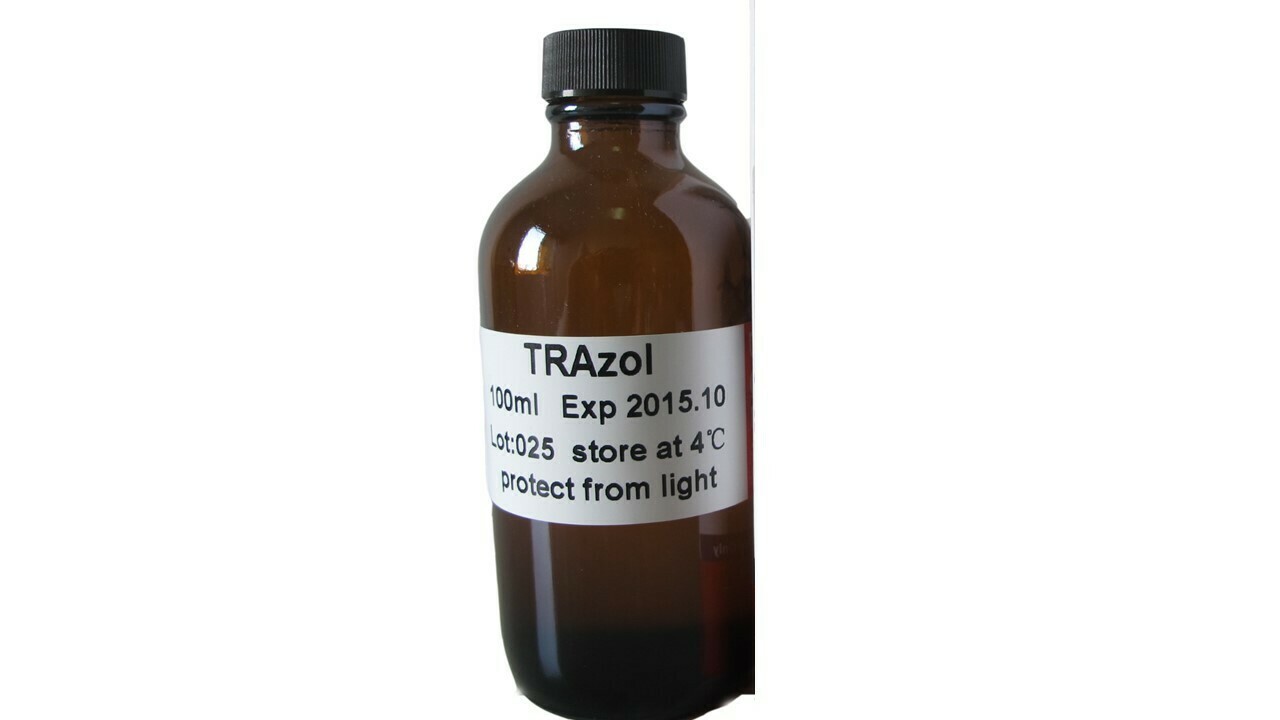
TRAzol 100 ml
100 Preps
Reagents required, but not supplied:
• Chloroform
• Isopropyl alcohol
• 75% Ethanol (in DEPC-treated water)
• DEPC-treated water
Description
Our TRAzol RNA Purification Kit provides a simple, reliable, and rapid method for isolating high–quality total RNA from a wide variety of samples, including animal and plant cells and tissue, bacteria, and yeast. The kit utilizes the strong lysis capability of TRAzol Reagent. TRAzol Reagent maintains the integrity of the RNA, while disrupting cells and dissolving cell components. Addition of chloroform followed by centrifugation, separates the solution into an aqueous phase and an organic phase. RNA remains exclusively in the aqueous phase. After transfer of the aqueous phase, the RNA is recovered by precipitation with isopropyl alcohol. After removal of the aqueous phase, the DNA and proteins in the sample can be recovered by sequential precipitation. Precipitation with ethanol yields DNA from the interphase, and an additional precipitation with isopropyl alcohol yields proteins from the organic phase. Co-purification of the DNA may be useful for normalizing RNA yields from sample to sample. Total RNA isolated by TRAzol Reagent is free of protein and DNA contamination. It can be used for Northern blot analysis, dot blot hybridization, poly (A)+ selection, in vitro translation, RNase protection assay, and molecular cloning.
Features
The most classic formula
The most widely used
The most stable yield
Storage
Store at 2-8°C, protect from light for up to 12 months.
Precautions for Preventing RNase Contamination
RNases can be introduced accidentally into the RNA preparation at any point in the isolation procedure through improper technique. Because RNase activity is difficult to inhibit, it is essential to prevent its introduction. The following guidelines should be observed when working with RNA.
Always wear disposable gloves. Skin often contains bacteria and molds that can contaminate an RNA preparation and be a source of RNases. Practice good microbiological technique to prevent microbial contamination.
Use sterile, disposable plasticware and automatic pipettes reserved for RNA work to prevent cross-contamination with RNases from shared equipment. For example, a laboratory that is using RNA probes will likely be using RNase A or T1 to reduce background on filters, and any nondisposable items (such as automatic pipettes) can be rich sources of RNases.
Recommended volume of TRAzol on different starting materials
| 10 cm2 adherent cells |
1 ml |
| 107 suspension cells |
1-2 ml |
| 100 μl white cells |
2 ml |
| 50-100 mg ordinary tissue |
1 ml |
| 50-100 mg special tissue(live, spleen, bone or cartilage) |
2 ml |
| 15-100 mg plant tissue |
1 ml |
Product Number: GR1022